
Stop searching the whole network. Know exactly where to send your leak crews first.

Fracta Leak Detection

Who It's For

Fracta Leak Detection is built for distribution system managers, water loss and non-revenue water (NRW) teams, operations superintendents, and the consulting engineers who support them. It is designed for utilities that survey miles of pipe with no clear starting point, or that only find leaks after a main breaks or a customer calls.

Survey budgets and crew hours are limited. Leak Detection tells you where to spend them first, so every field day covers the parts of the network most likely to be losing water.

What It Is

Fracta Leak Detection is an AI-driven service that ranks the areas of your distribution network most likely to contain leaks, and the pipes inside each area most worth investigating.

It starts with Fracta's Likelihood of Failure (LOF) model, which combines your pipe inventory and break history with environmental data Fracta supplies, such as soil, climate and topography. Adding a periodic SCADA export, our recommended path, turns that risk ranking into a leakage signal by showing where water is actually being lost.

Results are delivered as a map of priority areas in the Fracta platform, refreshed 1 to 4 times a year. No new sensors. No hardware in the ground. No live SCADA connection.

Why Utilities Use It

Shrink the Search Area

Instead of sweeping the entire network, crews start in the priority areas flagged in each delivery. Survey hours go to the parts of the system most likely to be leaking, not to miles of healthy pipe.

Recover Water and Revenue Sooner

Finding leaks earlier cuts non-revenue water and the cost of treating and pumping water you never bill. It also lowers the chance that a slow leak turns into an emergency main break.

Start With the Data You Already Have

All you need to begin is a pipe inventory and break history. There are no sensors to install, no live system integration and no prior Fracta assessment required. Send what you have and we confirm the scope.

How It Works

1. Data Collection

Only two datasets are required: a GIS pipe inventory (pipe ID, install date, material and diameter) and break history (a date plus pipe ID or location for each break). For the sharpest targeting, we recommend adding a SCADA export of hourly flows, tank levels and pressures in CSV or Excel, plus GIS of pressure zones and facilities. Gaps are fine; we tell you up front how they affect scope. We only ask for a SCADA export once a quarter. No live connection.

2. Risk Modeling

Fracta's LOF model scores every pipe segment by combining your records with environmental data we supply, including soil, climate and topography.

3. Leak Zone Prioritization

We combine pipe risk with the leakage signal in your SCADA data to flag priority areas for field investigation (the top 10% of the network in each delivery) so crews know where to begin.

4. Field Confirmation and Refresh

Your crews confirm leaks on site, or Fracta can include on-site pinpointing through a leak detection partner as an optional add-on. Updated priority areas arrive 1, 2, 3 or 4 times a year, timed so your team can investigate and act on each set before the next one lands.

Leak Detection Outputs

Priority Areas Map

Every delivery lands in the Fracta platform as a map of priority areas for leak investigation, so crews know where to start before they roll a truck.

Example Fracta Leak Detection output: priority areas (top 10%) flagged for field investigation. Demonstration data.
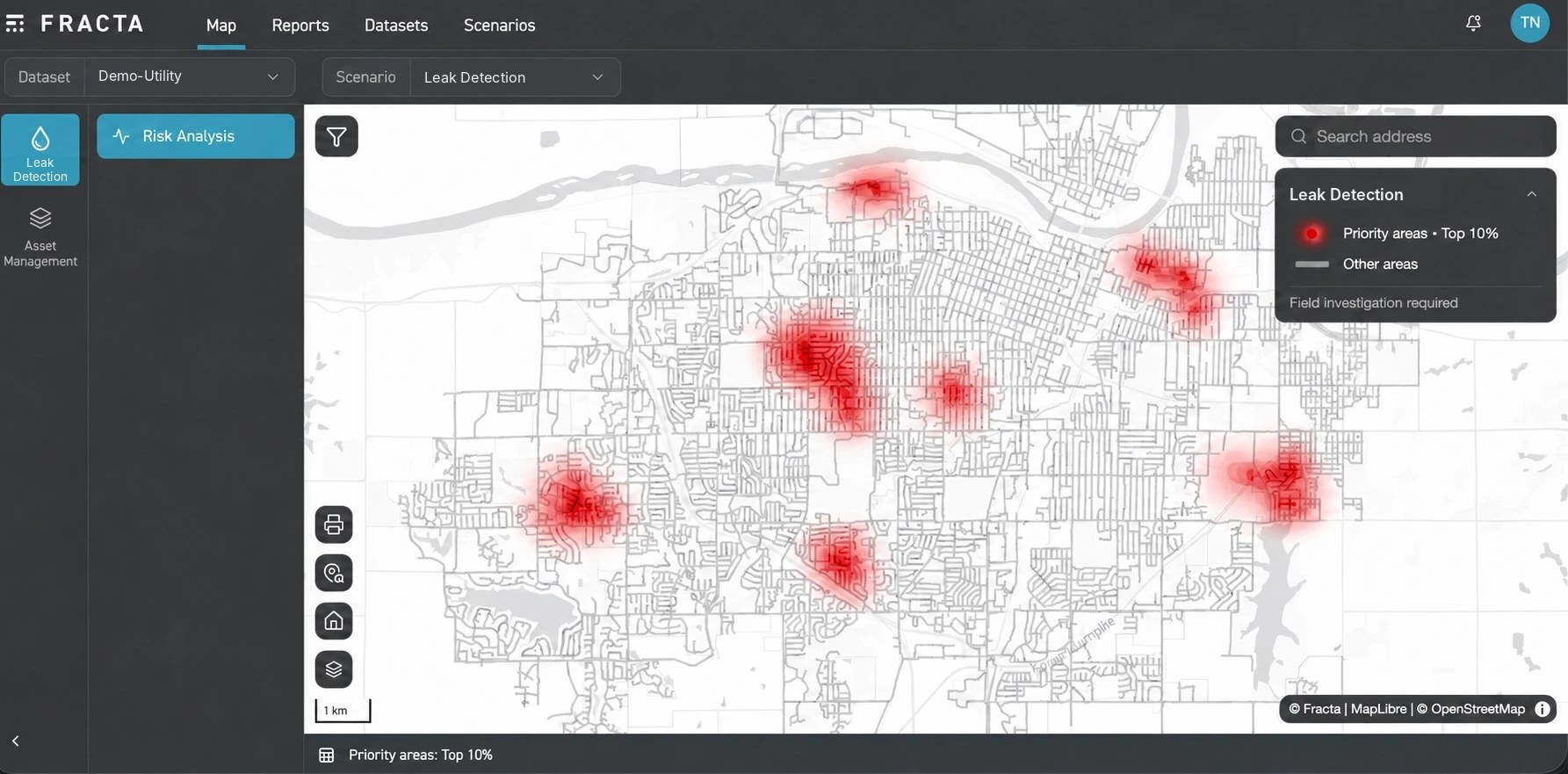
Fracta Leak Detection map showing priority areas flagged for field investigation

Four Delivery Packages

Choose how often you receive updated priority areas. Each package needs only one SCADA export per delivery, never a live connection.

PackageDeliveries per year
Bronze1
Silver2
Gold3
Platinum4

Optional Field Pinpointing

Prefer a turnkey service? Fracta can add on-site leak pinpointing through a leak detection partner, so you receive confirmed leak locations, not just priority areas.